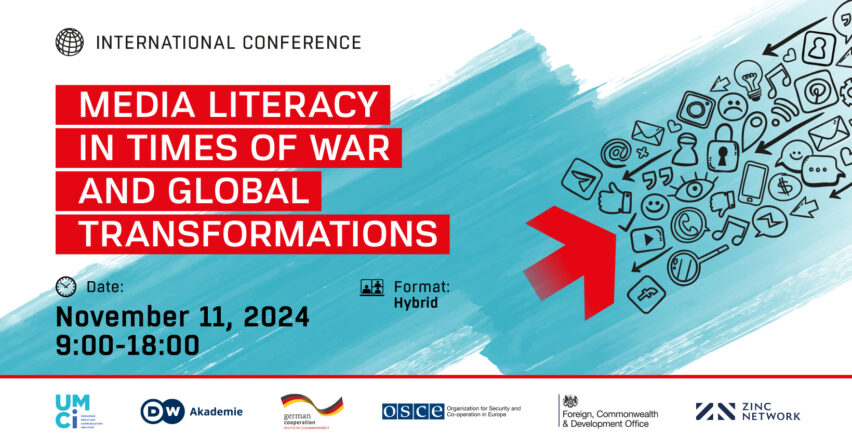
Date: November 11, 2024
Format: Hybrid (some foreign speakers will participate online)
Simultaneous interpretation: Ukrainian/English
9:30–10:00 — welcome speeches from the organizers and partners
- Dr. Maxim Ryabkov, Head of Unit Europe, DW Akademie (online)
- Olga Prokopenko, Head of Media Project, OSCE Support Program for Ukraine
- Charlotte Surun, Charge d’Affaires at the UK Embassy in Ukraine
- Diana Dutsyk, Executive Director of the Ukrainian Media and Communication Institute
10:00–11:45 — Session 1. International Collaboration in the Field of Strengthening Media Literacy of the Population Around the World. Ukraine’s Contribution
Moderator: Andriy Kulykov, Head of the Commission on Journalism Ethics (CJE)
Participants:
- Bettina Ruigies, Senior Adviser at the OSCE RFoM Office in Vienna
- Iryna Baran El Ghali, Project Coordinator, DW Akademie in Ukraine
- Maryna Bezkorovaina, Ukraine portfolio manager, EECAD Resilience Programme, British Embassy Kyiv
- Theresa Chorbacher, Project Officer Communication and Information UNESCO Desk Ukraine
- Gohar Khodjayan, Program manager of International Media Support in Ukraine, Moldova and Georgia
- Mehri Druckman, IREX Ukraine Country Director and Senior Advisor for Global Programs
Discussed topics:
- Should we maintain a universal approach to the development of media literacy in different countries on different continents, taking into account different contexts (political, economic, cultural, etc.)? What can and should be changed?
- How do digitalization, the development of AI and other technologies affect the construction of strategies for international organizations in the field of media literacy? How quickly will these strategies adapt to changes?
- What experience can Ukraine, Ukrainian experts and NGOs share with other countries, given their work in the context of war and aggressive Russian propaganda and disinformation?
11:45–12:15 — coffee break
12:15–12:30 — Guest speaker 1. Measuring Vulnerability of Society to Disinformation: How the Media Literacy Index Can be Used?
Marin Lessenski, Program Director, European Policies, OSIS (Open Society Institute — Sofia) (Bulgaria)
12:30–14:00 — Session 2. Quantitative Measures of Media Literacy: how to Study the Audiences and Measure Project Outcomes
Moderator: Dariya Orlova, PhD, Associate Professor at the Mohyla School of Journalism
Participants:
- Dennis Reineck, Deutsche Welle Akademie Senior Consultant (Germany)
- Iryna Negreeva, Independent Consultant, evaluator of projects in the field of democracy development and governance (Ukraine)
- Dr. Solvita Denisa-Liepniece, PhD, Assistant Professor, Vidzeme University of Applied Sciences/IREX, Riga
- Lyudmyla Yuzva, PhD, Research Program Manager, NDI Ukraine
- Ganna Krasnostup, Director of the Department of Information Policy and Information Security of the Ministry of Culture and Strategic Communications of Ukraine.
Discussed topics:
- Can media literacy indices reflect the real state of affairs? Do they only give an average picture?
- The number of studies conducted by different stakeholders has increased. Are these studies always of good quality?
- What research methods can be the most effective in the field of media literacy?
- How to assess the impact of media literacy projects? Can small organizations do this? What are the challenges in this area?
15:00–15:15 — Guest speaker 2. Reflecting on Information Disorder: What does a decade of research tell us about its impacts and effective strategies for mitigating its harms?
Claire Wardle, PhD, Associate Professor, Department of Communication, Cornell University (USA)
15:15–16:30 — Session 3. Strategies for Working with Vulnerable Audiences in the Field of Media Literacy in Wartime
Moderator: Anna Bezulyk, journalist, TV presenter
Participants:
- Dmytro Khilchenko, Project Director, ERP Media Literacy and Cognitive Resilience Project, Zinc Network
- Olga Pasitselska, Centre for Media and Journalism Studies, University of Groningen (the Netherlands) (online)
- Päivi Rasi-Heikkinen, Professor at the Center for Media Education at the Faculty of Education of the University of Lapland (Finland) (online)
- Olena Taranenko, Capacity Development Manager, IREX in Ukraine
- Valentyna Aksonova, Сommunications Мanager of the UNDP crisis response project group
- Svitlana Yeremenko, Executive Director of the Pylyp Orlyk Institute for Democracy
- Lyubov Naidyonova, Deputy Director of the Institute of Social and Political Psychology of the National Academy of Sciences of Ukraine
Discussed topics:
- What criteria can we use to determine the vulnerability of certain audiences? Why do we say that some audiences are more important, and others less vulnerable? Isn’t this approach wrong?
- How to motivate people under stress and war to pay attention to media literacy issues, especially when it comes to vulnerable audiences?
- Are the different training methodologies needed for the different population groups? And which ones?
- What should be the approach to producing content for these target audiences? Does it have to be different from creating content for a general audience?
16:30–16:45 — Guest speaker 3. Adapting media literacy to AI’s rapid evolution
Ramón Salaverría, Full Professor of Journalism School of Communication University of Navarra, The Head of the Center for Internet Studies and Digital Life (Spain)
16:45–18:00 — Session 4. Digitization and Development of AI as Challenges for the Field of Media Literacy
Moderator:
Olena Churanova, senior lecturer at the Mohyla School of Journalism, StopFake expert (agreed)
Participants:
- Arminas Muse, Education, Media and Information Literacy Expert (Lithuania)
- Anna Mysyshyn, Co-founder and Director of the Innovative Governance Institute (Ukraine)
- Oleksandra Yaroshenko, Mohyla School of Journalism NAUKMA
- Tetiana Avdeeva, Digital Security Lab, Senior lawyer
- Anastasia Korinovska, Manager and Editor, Suspilne
- Yevheniia Drozdova, Head of Data Journalism, Texty.org.ua
- Stanislav Lurie, Head of Osavul’s Ukrainian office
Discussed topics:
- What are the key challenges for the field of ML caused by AI and digitalization?
- What can be opposed to these challenges?
- What are the methods of working with audiences when discussing digitization and AI?
- What should we do with deepfakes?
- Ethics of interaction with AI.
18:00–19:00 — dinner/networking
The conference is organized by the NGO «Ukrainian Media and Communication Institute» in partnership with DW Akademie, with the financial support of the German Federal Ministry for Economic Cooperation and Development (BMZ), the OSCE Support Programme for Ukraine, The Foreign, Commonwealth & Development Office (FCDO), and ZINC Network. The views expressed during the event or in any related publications do not necessarily reflect the official positions of the partners.