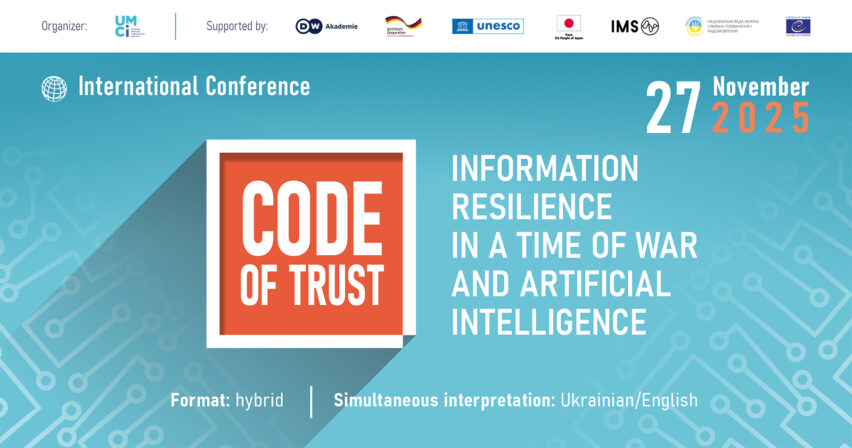
The Ukrainian Media and Communication Institute (UMCI) is holding the International Conference “Code of Trust: Information Resilience in a Time of War and Artificial Intelligence”, which will take place on November 27, 2025.
The conference will be held in a hybrid format and will include simultaneous interpretation (Ukrainian/English).
We invite experts, journalists, teachers and educators who focus on media literacy, librarians, and representatives of communities/local government bodies to participate.
Registration is mandatory:
- Conference participant registration form for offline/online participation (without hotel accommodation): https://forms.gle/ZnuNDwmN8mjD4BkK6
- Registration form for regional participants requiring hotel accommodation: https://forms.gle/3jAYvFNytND33hbA7
Program
9:00–9:30 — Welcome coffee
9:30–10:00 — Introductory plenary session. Keynote speeches (up to 5 minutes each):
- Prof. Chiara Dezzi Bardeschi, Head of the UNESCO Antenna in Ukraine
- Ms Hilde Haug, Deputy Head of the Council of Europe Office in Ukraine (online)
- Dr. Maxim Ryabkov, Head of Unit Europe, DW Akademie (online)
- Diana Dutsyk, Executive Director, UMCI
Moderator: Andriy Kulykov, Commission on Journalism Ethics (CJE)
10:00–11:30 — Panel 1. What Comes After Media Literacy? New Cultural, Educational and Policy Approaches to Information Resilience in Times of War
Moderator: Andriy Kulykov, Commission on Journalism Ethics (CJE)
Discussion Questions:
- How do changes in the information environment (digitalization, the development of AI, and the widespread dissemination of disinformation) affect media literacy policy? What approaches can help make society not just “media literate,” but information resilient?
- Should the state coordinate policy in this field, or should it remain primarily within the domain of civil society?
- Which cultural and educational practices help strengthen trust amid post-truth realities and information noise?
- How can “media literacy” be transformed into a component of national security?
Participants:
- Hanna Krasnostup, Head of the Department of Strategic Communications and Promotion of Ukrainian Culture, Ministry of Culture of Ukraine
- Olha Herasymiuk, Chair of the National Council of Television and Radio Broadcasting of Ukraine
- Salla Nazarenko, the CoE expert (online)
- Maryna Dorosh, Senior Technical Advisor, Learn to Discern in Education, IREX, Ukraine
- Inna Kilderova, Director General of the School Education Directorate of the Ministry of Education and Science of Ukraine
11:30–12:00 — Coffee
12:00–12:15 — Guest speaker 1. Media Literacy in the UK — Where Are We Now?
Julian McDougall, professor in media and education at Bournemouth University, chair of the Media and Information Literacy Alliance, academic adviser to the UK Government All Party Parliamentary Group on Political and Media Literacy
12:15–13:45 — Panel 2. Information Resilience in Times of War: How Changing Media Landscapes Reshape Democracy
Moderator: Viktoriia Sydorenko, Suspilne
Discussion Questions:
- How is the concept of freedom of speech changing in the era of disinformation, manipulation, and online censorship?
- What can media and society do to counter the influence of social media algorithms? Is cooperation possible?
- Where is the line between protecting society from harmful content and restricting freedom of expression?
- What is the current role of the media in shaping a resilient information environment?
- Can democratic institutions (including the media) adapt to an information landscape controlled by digital platforms?
Participants:
- Albertina Piterbarg, UNESCO’s Programme Coordinator for the Communication and Information Sector
- Oleksandr Burmahin, Member of the National Council of Television and Radio Broadcasting of Ukraine
- Kristina Rud, Public Interest Tech Adviser, IMS
- Nataliia Lygachova, Head of the NGO ‘Detector Media’
- Zakhar Protsiuk, Chief Operating Officer at the Kyiv Independent
13:45–14:45 — Lunch
14:45–15:10 — Guest speaker 2. How Media and Information Literacy Restores Trust and Social Engagement Among Vulnerable Groups During Wartime
- Diana Dutsyk, UMCI
- Lidiya Malyovana, Participant of the Information Resilience Workshops (Hansen Miracle Village)
15:10–16:30 — Panel 3. Media and Information Literacy as a Tool for Socialization of Vulnerable Population Groups in a Context of War.
Moderator: Tetyana Stroy, Pylyp Orlyk Institute for Democracy
Discussion Questions:
- What social barriers prevent vulnerable groups from fully participating in the digital environment? Should we talk about “information inequality” in this context as a new form of social inequality?
- Can the development of media and information literacy be part of rehabilitation and psychological support for people who have experienced war, loss, or forced displacement?
- What role can local media, libraries, cultural centers, and civil society organizations play in creating “spaces of trust” for learning?
- What potential and actual partnerships are possible between business, government, and communities to enhance the information resilience of vulnerable groups?
Participants:
- Olena Taranenko, Capacity Building Manager, IREX in Ukraine
- Oksana Bruy, President of the Ukrainian Library Association
- Oleksandra Kondrasheva, Director of Senior Chudo Village
- Inna Yermakova, Media Trainer, Senior Lecturer at the Department of Journalism and Social Communications, Vasyl Stus Donetsk National University
- Alina Khaletska, Head of the NGO “Association of Universities of the Third Age “Klepsydra””
16:30–16:45 — Guest speaker 3. How AI is disrupting media business models and the need for journalism to pull away from big tech platforms
Paul McNally, IMS’s AI Advisor
16:45–18:00 — Panel 4. Beyond the Algorithm: Digital Sovereignty, AI, and the Future of Information Empowerment
Moderator: Aliona Romaniuk, NotaYenota
Discussion Questions:
- What role does AI play in shaping public opinion, and how can citizens learn to recognize algorithmic manipulation?
- AI is changing the architecture of disinformation (from content creation to dissemination). What approaches to developing information resilience can be effective under these conditions?
- What lessons and case studies (e.g., in countering deepfake campaigns) can Ukraine and Ukrainian organizations offer to other countries amidst growing security threats?
- How can nations ensure their digital sovereignty when major digital platforms are based outside their jurisdictions? Can this be achieved without limiting the freedom of the information space?
- Is “shared responsibility” (government, tech companies, society) for the information future possible? What cooperation models are feasible?
Participants:
- Olga Boichak, Director of the Computational Social Science Lab in the Faculty of Arts and Social Sciences, University of Sydney (video)
- Olga Kravchenko, Head of the National Media Literacy Project ‘Filter’
- Tetiana Avdieieva, Senior Lawyer at the Digital Security Lab Ukraine
- Yuliia Dukach, Head of Disinformation Investigations at OpenMinds
- Hordii Rumiantsev, Member of the Expert Committee on AI under the Ministry of Digital Transformation of Ukraine
- Oleksii Minakov, Consultant on the Implementation and Use of Generative AI
18:00–18:10 — Closing Remarks and Summary: Trust as a Strategy
18:10–19:00 — Dinner/networking
The conference is organized by the NGO “Ukrainian Media and Communication Institute” in partnership and with the financial support of the DW Akademie, the German Federal Ministry for Economic Cooperation and Development (BMZ), UNESCO Antenna in Ukraine with the support from the Government of Japan, Council of Europe project “Safeguarding Freedom of Expression and Freedom of Media in Ukraine – Phase II”, IMS, in partnership with the National Council of Television and Radio Broadcasting of Ukraine. The views expressed during the event or in any related publications do not necessarily reflect the official positions of the partners.